
Understanding Good Samaritan Laws: Why You Shouldn’t Be Afraid to Help in an Emergency

Many people hesitate to help during a medical emergency because they worry about one thing: “What if I get sued?”
It’s a common concern. But in most cases across the United States, the law actually protects people who step in to help during emergencies. These protections are called Good Samaritan laws, and they exist specifically to encourage bystanders to provide lifesaving care when it matters most.
Understanding these laws can help remove one of the biggest barriers that prevents people from acting in an emergency.
What Are Good Samaritan Laws?
Good Samaritan laws are legal protections that shield individuals from liability when they voluntarily help someone during a medical emergency.
In simple terms, the law recognizes that:
Emergencies are chaotic
Bystanders are doing their best to help
Immediate action can save lives
As long as a person acts in good faith and within the limits of their training, they are generally protected from being held legally responsible if the outcome is not perfect.
These laws exist in all 50 states, although the exact wording and details vary slightly by state.
When Do Good Samaritan Protections Apply?
While the specifics differ depending on where you live, Good Samaritan laws usually apply when a person:
Provides emergency care voluntarily
Does not expect payment
Acts reasonably based on their training or knowledge
Does not act with gross negligence or intentional harm
For example, protections typically apply if a bystander:
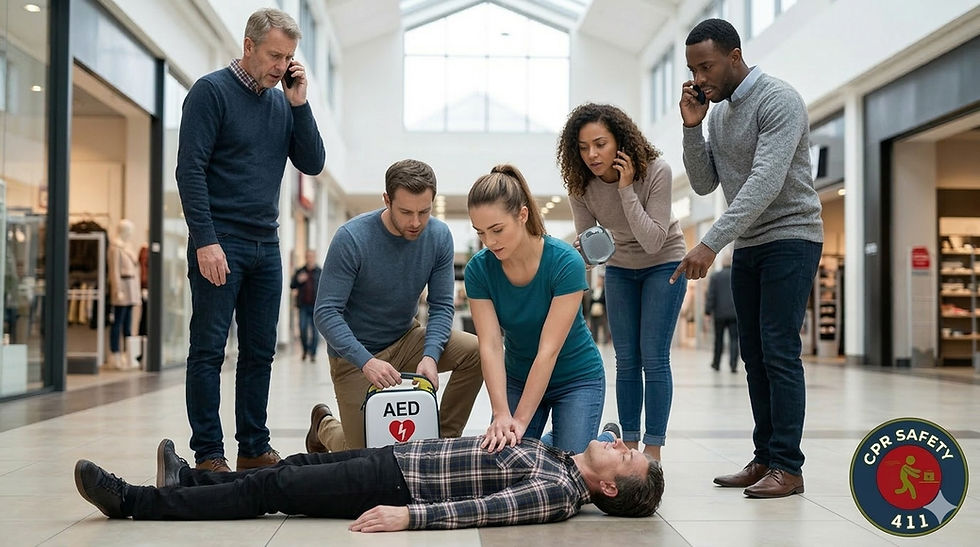
Performs CPR on someone in cardiac arrest
Uses an AED (Automated External Defibrillator)
Helps someone who is choking
Provides basic first aid until emergency responders arrive
The goal of these laws is simple: encourage people to help rather than stand by and do nothing.
What Good Samaritan Laws Do NOT Protect
It’s important to understand that Good Samaritan laws are not a free pass for reckless behavior.
Protection usually does not apply if someone:
Acts with gross negligence
Intentionally harms the victim
Provides care far outside their level of knowledge
Abandons the person after beginning care without ensuring help is coming
However, situations like these are extremely rare. The law generally favors the person who tries to help in good faith.
Are You Required to Help?
In most states in the U.S., bystanders are not legally required to help someone during an emergency.
However, a few states do have “duty to assist” laws requiring people to call for help or provide reasonable assistance if they can do so safely.
Even where it’s not required, taking action can make the difference between life and death.
How This Applies to CPR and AED Use
One of the most important reasons Good Samaritan laws exist is to support bystander CPR and AED use.
Sudden cardiac arrest can happen anywhere — at home, in the workplace, at the gym, or in public spaces.
When someone experiences cardiac arrest:
Brain damage can begin within 4–6 minutes
Emergency responders often take longer than that to arrive
This is why immediate action from bystanders is so critical.
Good Samaritan protections help ensure that someone who performs CPR or uses an AED is protected when trying to save a life.
Training Builds Confidence
Although Good Samaritan laws provide protection, many people still hesitate because they are unsure what to do in an emergency.
That’s where training makes a difference.
Learning CPR, AED use, and basic first aid helps people:
Recognize emergencies quickly
Respond with confidence
Provide effective care until professionals arrive
Even a short training session can give someone the knowledge needed to step in during those critical first minutes.
The Bottom Line
Good Samaritan laws exist for one reason: to encourage people to help during emergencies without fear of legal consequences.
When someone’s heart stops or a serious medical emergency occurs, the first person on scene is often not a doctor or paramedic — it’s a bystander.
Your willingness to act could be what saves a life.
Learn Lifesaving Skills
At CPR Safety 411, we provide training in:
CPR
AED use
First Aid
Basic Life Support (BLS)
Instructor courses for those who want to teach lifesaving skills
Training can help you feel confident and prepared if an emergency ever happens at home, work, or in your community.
Learn more or request a class at CPR411.com.

Comments