
Why Narcan Training Is Being Added to CPR Classes in 2026
Updated: Mar 12
Across the United States, many workplaces are expanding their emergency preparedness programs.
In 2026, organizations aren't just training staff in CPR and AED use anymore. Many are also adding naloxone (Narcan) training as part of their safety planning.
The reason is simple: opioid overdoses remain a serious public health issue, and early intervention can save lives.
Recent American Heart Association (AHA) guidelines updates highlight opioid overdose response as an important component of modern resuscitation education for both professionals and lay rescuers.
For many organizations, this means that the modern CPR class is evolving to include overdose recognition and naloxone administration alongside traditional CPR skills.
Why Naloxone Training Is Being Paired With CPR
Naloxone (often known by the brand name Narcan) is a medication that can rapidly reverse the life-threatening breathing suppression caused by opioid overdoses.
It works by temporarily blocking opioid receptors in the brain, restoring breathing long enough for emergency medical services to arrive.
In many ways, naloxone plays a role similar to an Automated External Defibrillator (AED) in cardiac arrest.
Both tools:
Address a specific life-threatening condition
Can be used by trained bystanders
Help stabilize a patient until EMS arrives
When CPR, AED, and Narcan training are taught together, responders learn how to:
Recognize the signs of opioid overdose
Call 911 quickly
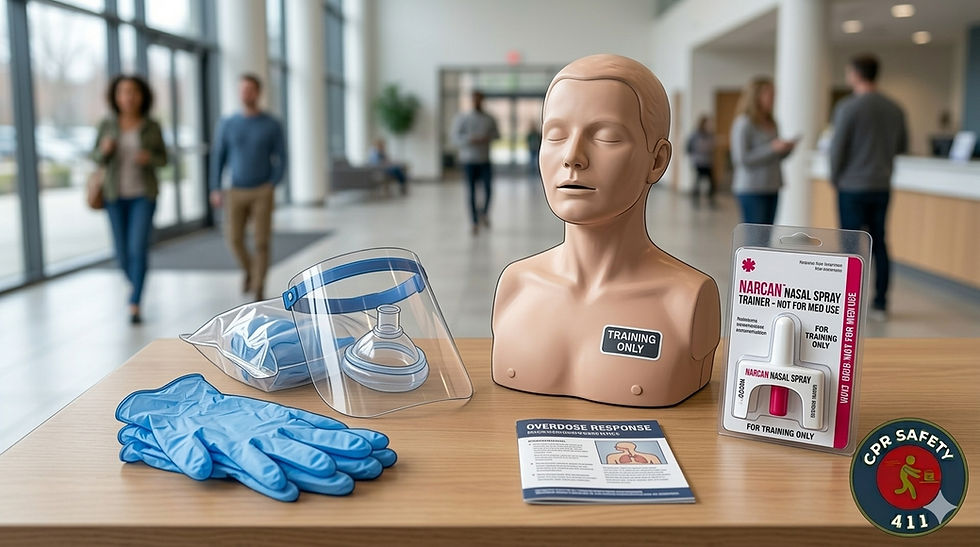
Administer naloxone nasal spray
Begin CPR if the person is not breathing normally
These skills give rescuers the confidence to act during emergencies that increasingly occur in public places and workplaces.
What the Updated AHA Guidance Says About Opioid Overdose
Recent American Heart Association guidance places greater emphasis on opioid overdose recognition and response.
The guidelines highlight the importance of public access to naloxone, similar to the public-access defibrillation programs that have placed AEDs in many workplaces, schools, and community buildings.
The new guidance encourages communities and organizations to make naloxone available and ensure staff understand how to respond to suspected overdoses.
Typical signs of opioid overdose include:
Slow, shallow, or stopped breathing
Unresponsiveness
Gurgling or choking sounds
Very small pupils
Bluish or gray skin tone
Recognizing these signs quickly allows bystanders to activate emergency services and begin lifesaving interventions.
What Opioid Overdose Response Looks Like
While training should always be completed through a certified course, the general response process includes:
Check responsiveness and breathing
Call 911 immediately
Administer naloxone (Narcan) if available
Begin CPR if the person is not breathing normally
Stay with the person until EMS arrives
In many situations, naloxone helps restore breathing within minutes, but additional doses may be required until professional help arrives.
Learning these steps through a CPR and First Aid class helps ensure that responders can act calmly and confidently during a real emergency.
You can learn more about what happens in a CPR class here: What Happens During a CPR Class
How Workplaces Are Updating Safety Programs
Organizations across the country are modernizing their emergency preparedness programs to reflect current public health challenges.
Many workplaces, schools, and community organizations are now:
Placing naloxone kits near AEDs and first aid supplies
Training staff to recognize opioid overdoses and administer Narcan nasal spray
Integrating overdose scenarios into CPR and emergency response drills
These updates help ensure that safety programs reflect today's risks rather than relying solely on traditional emergency training.
Workplaces that commonly add naloxone training include:
Healthcare and dental offices
Schools and childcare programs
Community centers and churches
Manufacturing and industrial workplaces
Fitness facilities and sports venues
For many organizations, naloxone training is becoming a natural extension of CPR and First Aid education.
Accessing Naloxone (Narcan)
One concern people often have is how to obtain naloxone.
Fortunately, many programs now provide free or low-cost naloxone kits through public health initiatives and harm-reduction programs.
NEXT Distro
A national harm-reduction organization that provides mail-based naloxone programs and connects people with local distribution partners.
National Harm Reduction Coalition Naloxone Finder
An online tool that helps individuals locate free naloxone programs throughout the United States.
State and Local Health Departments
Many states provide naloxone through pharmacies, public health events, or mail distribution programs.
In Pennsylvania, standing pharmacy orders and community distribution programs make it easier for individuals and organizations to obtain naloxone without needing a personal prescription.
Why Adding Narcan Training Strengthens CPR Education
If your last CPR class did not cover opioid overdose response, your training may not reflect the newest public health priorities.
Adding naloxone education to CPR and First Aid classes helps organizations:
Align with modern emergency response recommendations
Prepare staff for a wider range of emergencies
Build confidence responding to suspected overdoses
For many organizations, overdose response training simply becomes another essential life-saving skill alongside CPR, AED use, and choking relief.
Training Opportunities in Pennsylvania
Organizations across Williamsport, Lewisburg, State College, Harrisburg, Bloomsburg, Scranton, Allentown, and surrounding regions regularly schedule on-site CPR and First Aid training for staff and volunteers.
Training programs can be customized for workplaces, healthcare offices, childcare programs, churches and nonprofit organizations, and fitness facilities.
If your organization is interested in training that includes CPR, AED use, and overdose response education, you can request information here:


Comments